
Overview:
The guide provides a straightforward, room by room approach for choosing surfaces that will seem refined both today and in twenty years' time; all of the recommendations are based on the fact that the area has a humid climate which is prone to storms and that therefore moisture control, corrosion resistance and ease of maintenance are the factors which decide what will remain timeless. [1][8]
The stakes are simple: manage moisture well and you protect both your health and your investment. [1] You’ll find practical picks for countertops, tile by space, finish hardware suited to salt air, and the code and resilience choices that quietly keep luxury finishes looking new.
Guide Index
In the Lowcountry, plan selections around moisture first—poor moisture management leads to mold and durability issues. [1]
Quartz is a smart primary-kitchen countertop for high-end projects because it pairs consistent beauty with low upkeep in humidity. [5]
Choose coastal-grade fixtures—especially PVD-coated hardware and plumbing—to slow salt-air corrosion and protect adjacent grout and stone from staining. [8][13]
Expect site and code factors like impact-rated windows and elevated assemblies to shape transitions, thresholds, and waterproofing around kitchens and baths. [8][9]
Build in resilience touches—surge protection, elevated electrical components, and controlled drainage—so systems and finishes weather storms without costly rework. [8][11]
Want to go further? Book a time now with one of our tried professionals. Start Here→
Similar Topics
Title
A little something about information on the blog.

Title
A little something about information on the blog.
How to choose tile and countertops that age gracefully in the Lowcountry
In our experience building luxury homes in the Lowcountry, the best selections begin with how each room will actually work. Use these priorities to narrow the options before deciding on pattern and color:
Start with the room: Consider traffic, spill and heat exposure, sunlight, and your true cleaning tolerance. A primary kitchen with heavy cooking calls for different performance than a scullery, laundry, or powder room.
Prioritize moisture resistance: Favor nonporous or sealed countertops and dense porcelain or ceramic tile in splash zones. Match ventilation to the way you will use showers, tubs, and steam features. [1][2][4][5]
Choose a timeless foundation: Look for subtle movement and neutral tones such as cream, sand, and shell-gray. Reserve bold veining or saturated color for accents or smaller spaces that are easier to refresh.
Let the site drive the specifications: Elevated homes and wind-driven rain can increase splash and grit at porches and thresholds. [8] Use dense, scratch- and stain-resistant surfaces near these transitions.
Coordinate the surrounding finishes: Pair tile and countertops with coastal-grade fixtures, including PVD-coated and marine-conscious hardware, so corrosion does not stain grout lines or adjoining stone. [8][13]
If you’re still interviewing builders and designers, look for a local team that can integrate selections with the climate and your daily routine. In our experience, a strong portfolio of cohesive, enduring projects and a process built on communication are the best indicators that you will get both the performance and the look you want. See how our team approaches this in our guidance on selecting a custom home builder in the Lowcountry.
Countertop materials: pros, cons, and where they excel
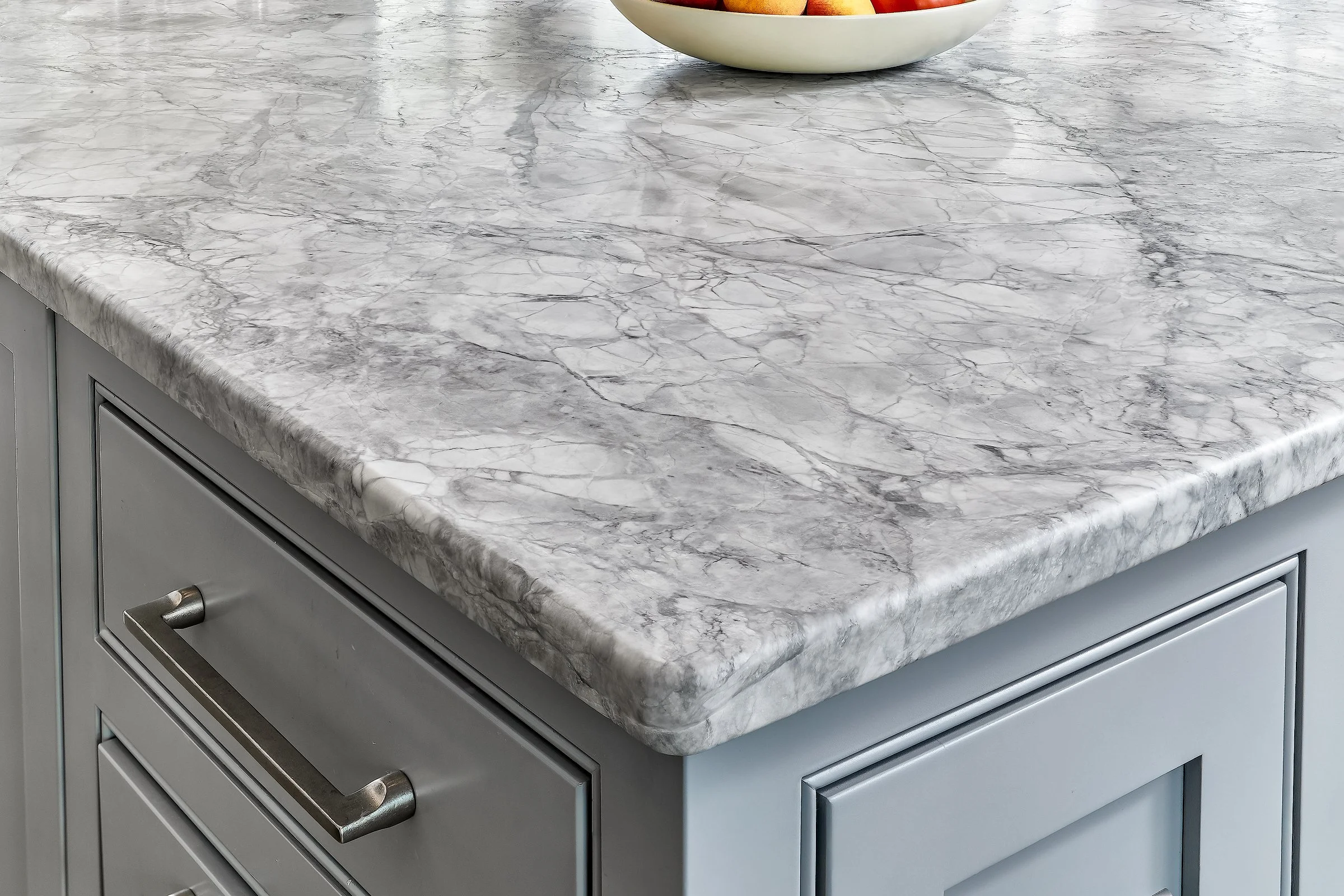
Quartz: A reliable primary-kitchen choice in coastal homes. It offers consistent patterning, resists stains, and keeps upkeep simple—qualities that matter when humidity and daily cooking are givens. It also performs well for busy family bathrooms and laundry counters. [5]
Marble: Nothing matches its classic depth and elegance. Use honed finishes on vanities, powder rooms, or dedicated baking areas to reduce the appearance of etching. In high-acid prep zones, combine marble accents with a main work surface in quartz or a durable natural stone. [6]
Granite and other natural stones: Beautiful and durable when you match the stone to its porosity and finish. In kitchens, select lower-porosity varietals and pair them with the right sealer to manage humidity and spills. Test samples with oils, lemon, and cleaners before committing. [6]
Sintered/porcelain slabs: Standouts for heat and UV stability—excellent near sunny windows, in butler’s pantries with appliances, and for outdoor kitchens. Confirm edge profiles, seam plans, and substrate support early; these slabs demand precise fabrication and installation details. [7]
Butcher block or accent stone: Use sparingly to warm up an island or breakfast bar. In a humid climate, sealing and airflow matter because surrounding humidity influences wood moisture content and dimensional stability. [10] Plan ventilation gaps around appliances and commit to regular oiling or sealing to keep the material stable and sanitary.
For visual continuity, many clients carry a primary stone from the kitchen to the scullery or bar. Explore how continuity plays out across plans in our portfolio.
Tile that works room by room
Kitchens: Choose dense porcelains or high-quality ceramics with low water absorption. [2] At entries from porches or pools, specify slip-resistant finishes and a subtle texture to manage grit. [3] Stick with classic field tile—subway, herringbone, or stacked layouts—in neutral tones for backsplashes and hearth walls.
Primary baths: Porcelain slabs or large-format porcelains minimize grout for a calm, sophisticated feel—and easier cleaning. [4] Pair with robust ventilation to handle steam and long showers. [1] Use corrosion-resistant trims and fixtures so metal doesn’t tea-stain tile edges. [8]
Mudrooms/laundry: Look for textures that disguise sand and salt, and consider darker grout for longevity. Rectified tiles allow minimal joints, which helps cleaning and keeps lines crisp even with daily traffic. [4]
Outdoor/screened porches: Exterior-rated porcelain pavers or tile are the sweet spot for moisture resistance and stability. [2][3] Screened porches expand daily use in buggy months and keep grit off adjacent interiors—see how material choices support year-round comfort in our notes on designing outdoor living spaces for Lowcountry summers.
Pool surrounds and thresholds: Exterior-rated anti-slip porcelain helps with safety and cleaning. [3] Plan drainage and slopes carefully, and coordinate corrosion-resistant metal trims and fasteners so salt air doesn’t stain grout or tile. [4][8]
Coastal resilience that protects surfaces (and your investment)
In our experience, the most successful Lowcountry finish plans treat resilience as part of the selection process, not as a separate construction issue:
Coordinate transitions early: Elevated homes and storm-ready envelopes shape how finishes meet thresholds, sills, and decks. Align tile heights, expansion joints, and waterproofing at doorways to manage wind-driven rain and avoid chipped edges or lippage. [4][8]
Specify for salt air: Use corrosion-resistant alloys and finishes, isolate dissimilar metals, and select compatible sealants so corrosion stains do not migrate onto tile, grout, or countertops. [8]
Finalize openings before finishes: Impact-rated window and door profiles affect tile terminations and pan details. [9] Resolve thresholds and sill designs early so interior stone and exterior tile meet cleanly and remain watertight.
Control water at the site: Coordinate stormwater strategies with the site and landscape teams to reduce splash-back against cladding and porch surfaces. [1][8] Controlled water is cleanable water, and cleanable water preserves finishes.
Maintenance, lifecycle cost, and insurance realities
Reduce corrosion-related replacement: Choose PVD-coated fixtures and coastal-grade hardware to protect adjacent grout and stone from staining in salt air. [8][13]
Plan ahead for storms: Flood insurance typically carries a 30-day waiting period, so secure coverage well before peak season and coordinate temporary surface protection during punch-out. [12]
Protect electrical systems: Mount key components with flood elevation in mind, and use whole-home surge protection for appliances integrated with stone and tile. [8][11]
Simplify outdoor upkeep: Beside tiled porches and pool areas, composite decking provides durable, low-maintenance performance that pairs well with porcelain pavers.
To connect the dots between resilience and efficiency-minded specs, see our guidance on balancing luxury and sustainability in energy-efficient home design.
Plan the power and tech so kitchens and baths keep working
Plan for current and future loads: Size service capacity for today’s appliances and tomorrow’s upgrades, and leave expansion room in the panel so walls do not need to be reopened later. [11]
Separate major demands: Include dedicated Level 2 EV charging circuits so garage loads do not compete with kitchen or HVAC performance. [14]
Protect wet-zone systems: Use elevation strategies and sealed penetrations to protect wires, outlets, and under-cabinet lighting from moisture intrusion. [8]
Add whole-home surge protection: Protect appliances installed within stonework or used on tiled counters. [11]
For a deeper dive into service sizing, surge protection, and elevation strategies that protect finished spaces, explore what defines a luxury electrical system in a Lowcountry custom home.
Timeless design moves (that never read trendy)
Nature-rooted palettes—think sand, shell, driftwood—create calm, cohesive backdrops. Use restrained veining and texture for depth; bring color with paint and textiles you can refresh over time.
Lead with proportion, not ornament. Larger-format tiles with balanced grout and simple edge profiles—eased or beveled—feel refined longer than intricate borders or heavy inlays.
Repeat materials with intention. Carry a primary stone from kitchen to scullery, or extend a bathroom’s tile into the shower for a seamless, spa-like effect without visual fatigue.
Keep finishes cohesive. Align corrosion-resistant metals and cabinet hardware so fixtures age together without spotting that can prematurely date the look.
If you’re coordinating across multiple spaces, review how continuity pairs with plan types in our luxury floor plans.
Frequently Asked Questions
What countertop is best for a primary kitchen in the Lowcountry?
Quartz is the best countertop for primary kitchens in the Lowcountry because it combines durability, low maintenance, and a consistent appearance. [5] A properly sealed, lower-porosity granite is the best natural-stone alternative. [6]
Are marble countertops a mistake in a humid coastal climate?
No. Marble works best in vanities, powder rooms, and baking zones where acid exposure is limited. Use quartz or dense granite in high-acid prep areas, and clean marble with pH-neutral products. [6]
What tile holds up best for outdoor porches and pool decks?
Exterior-rated porcelain pavers with an appropriate wet-area slip-resistance classification are the best choice for Lowcountry porches and pool decks. [2][3] Pair them with corrosion-resistant trims and fasteners near the coast. [8]
Do coastal codes really affect my finish selections?
Yes. Coastal wind, flood, and opening-protection requirements directly affect thresholds, waterproofing, sill details, and finish elevations. [8][9] Coordinate these details before tile and stone installation to prevent lippage and rework. [4]
How soon should I handle insurance and storm planning during a build?
Begin insurance and storm planning before substantial completion. NFIP flood insurance typically has a 30-day waiting period, and flood-zone electrical elevations and sealant details should be confirmed before tile or slab installation. [8][12]
If you’re ready to translate this framework into a home that feels effortless day to day, our team brings design, selections, and build under one roof for the Lowcountry. Explore our custom homes, and reach out when you’re ready to specify tile and countertops for your site.
-
[1] U.S. Environmental Protection Agency. “A Brief Guide to Mold, Moisture and Your Home.” Explains that moisture control is central to mold prevention and recommends prompt drying, ventilation, drainage, and indoor humidity control. EpaA Brief Guide to Mold, Moisture and Your Home | US EPAMore actions
[2] Tile Council of North America. “Porcelain Certification.” Defines porcelain tile as having a water-absorption rate of 0.5 percent or less under ASTM C373 and explains independent PTCA certification. TcnatilePorcelain Certification | Tile Council of North AmericaMore actions
[3] Tile Council of North America. “Dynamic Coefficient of Friction.” Explains ANSI A326.3 testing and product-use classifications for hard-surface flooring, including interior and exterior wet applications. TcnatileDynamic Coefficient of Friction | Tile Council of North AmericaMore actions
[4] Tile Council of North America. “2026 TCNA Handbook for Ceramic, Glass, and Stone Tile Installation.” Provides recognized installation methods and guidance for substrates, wet areas, grout joints, movement accommodation, large-format tile, and exterior applications. Tcnatile2026 TCNA Handbook for Ceramic, Glass, and Stone Tile Installation - PROFLEX | Tile Council of North AmericaMore actions
[5] International Surface Fabricators Association. “Classification and Standards for Quartz Surfacing Material, ISFA 3-01.” Establishes minimum performance requirements and test methods for quartz surfacing materials. IsfanowQuartz Standards - International Surface Fabricators AssociationMore actions
[6] Natural Stone Institute. “Care & Cleaning of Natural Stone.” Explains geological differences among stones, acid sensitivity, scratching, sealing, stain resistance, and appropriate cleaning practices. NaturalstoneinstituteLearn About Cleaning Products for Natural StoneMore actions
[7] International Surface Fabricators Association. “Porcelain Fabrication Training.” Addresses the specialized handling, cutting, seaming, substrate, installation, finishing, and repair requirements of porcelain, ultra-compact, and sintered surfaces. IsfanowPorcelain Fabrication Training - International Surface Fabricators AssociationMore actions
[8] Federal Emergency Management Agency. “Flood Damage-Resistant Materials Requirements, Technical Bulletin 2.” Addresses flood-resistant materials, coastal salt exposure, corrosion-resistant fasteners and connectors, and materials used below the Base Flood Elevation. Femafema.gov/sites/default/files/2020-07/fem...More actions
[9] International Code Council. “2021 South Carolina Residential Code, Section R301.2.1.2: Protection of Openings.” Establishes windborne-debris protection requirements for exterior glazing in applicable regions. IccsafeDigital CodesMore actions
[10] U.S. Department of Agriculture, Forest Service, Forest Products Laboratory. “Moisture Relations and Physical Properties of Wood.” Explains how surrounding humidity and temperature influence wood moisture content, dimensional stability, shrinkage, and swelling. UsdaChapter 4: Moisture relations and physical properties of wood | US Forest Service Research and DevelopmentMore actions
[11] National Fire Protection Association. “Changes to the 2020 NEC That Impact Residential Electrical Services.” Explains electrical-service considerations and the NEC requirement for surge-protective devices at dwelling-unit services. NfpaResidential Electrical Installations | NFPAMore actions
[12] Federal Emergency Management Agency. “Flood Insurance.” States that an NFIP policy typically has a 30-day waiting period before coverage becomes effective, subject to specified exceptions. FemaFlood InsuranceMore actions
[13] Vorobyova, Mariya, et al. “PVD for Decorative Applications: A Review.” Materials, vol. 16, no. 14, 2023. Reviews PVD as a protective, hard coating and discusses performance considerations, quality control, corrosion behavior, and limitations in decorative applications. Doidoi.org/10.3390/ma16144919More actions
[14] U.S. Department of Energy, Alternative Fuels Data Center. “Charging Electric Vehicles at Home.” Explains that residential Level 2 charging typically uses 240-volt equipment and that an electrician should verify available electrical capacity and code compliance. EnergyAlternative Fuels Data Center: Charging Electric Vehicles at HomeMore actions
Have more questionS?
Set up a meeting to talk more about your dream home.
Dreaming of a home that feels built just for you? Coastal Signature Homes turns that vision into a smooth, confident reality. We guide you from first concept to final walk-through with experienced professionals, thoughtful design, and transparent communication at every step.
Why choose Coastal Signature Homes?
Personalized design: We listen to your lifestyle and priorities, then translate them into practical floor plans and refined finishes. Every decision is tailored to your needs — not a one-size-fits-all template.
Transparent process: Clear timelines, itemized budgets, and regular progress updates keep you informed and in control. No surprises, just steady progress.
Quality craftsmanship: We partner with skilled tradespeople and use reliable materials to deliver lasting value. Attention to detail and practical durability are built into every home.
Efficient project management: Our experienced team coordinates permits, inspections, subcontractors, and scheduling so the build stays on track and on budget.
Flexible options: Whether you want coastal-inspired, contemporary, or classic styling, we adapt plans and finishes to match your aesthetic and functional goals.
Strong warranty and support: After move-in, we stand behind our work with follow-up service to ensure your home performs as promised.
Explore More

Learn More About Kane Island

Find Inspiration

House Plans